 By Meghna Sharma
A hospital bill is only one financial consequence of a serious accident. The injured person may also lose the ability to work, require long-term assistance or experience a permanent disability that changes the household’s income.
Health insurance is designed primarily to address eligible medical expenses. It can pay for hospitalisation, surgery and other covered treatments, but it does not ordinarily compensate someone simply because an accident has caused permanent disability or reduced their earning capacity.
Personal accident insurance addresses a different financial risk: accidental death and specified disabilities resulting from an accident.
For Indian families, understanding this distinction matters because even a comprehensive health insurance policy may leave significant gaps in financial protection.
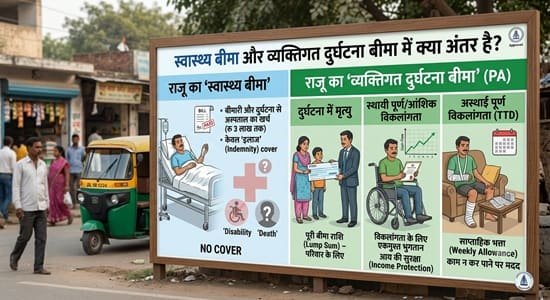
The Financial Loss That Medical Insurance Cannot Fully Address
Consider a self-employed electrician who suffers a serious accident and receives hospital treatment.
A health insurance policy may cover eligible medical expenses, subject to its limits, deductibles and exclusions.
But settling the hospital bill does not replace the electrician’s future earnings if the accident causes a permanent disability.
The household may still need money for rent, education, loan repayments and everyday expenses.
Personal accident insurance can provide a predetermined benefit when an insured accident results in a covered disability.
Unlike conventional indemnity-based health insurance, which reimburses or settles eligible treatment costs, core personal accident benefits are generally linked to the insured event and the policy’s benefit schedule.
This makes the two forms of protection complementary rather than interchangeable.
Accidental Death: Financial Support for Dependants
One of the principal benefits of personal accident insurance is accidental death cover.
If the insured person dies because of a covered accident and the claim meets the policy conditions, the insurer pays the specified benefit to the eligible nominee or beneficiary.
A standard health insurance policy generally does not provide an accidental death benefit merely because the insured person dies.
It may cover eligible treatment expenses incurred before death, but that is different from paying an agreed death benefit.
Personal accident policies commonly specify a time limit within which death must result from the accident for the benefit to apply.
The exact conditions vary between products.
Permanent Total Disability: Protection Against Loss of Independence
Permanent total disability is another important component of personal accident insurance.
It generally concerns specified severe disabilities resulting from an accident, as defined in the policy.
Depending on the contract, qualifying events may include permanent loss of specified bodily functions or other disabilities meeting the insurer’s definition.
The benefit is usually calculated as a stated percentage of the insured sum.
For someone whose income depends heavily on physical work, this protection can be particularly valuable.
However, policy definitions are critical. An inability to perform one’s usual occupation does not automatically qualify as permanent total disability under every plan.
Permanent Partial Disability: When the Loss Is Not Total
An accident can cause a lasting impairment without meeting the definition of total disability.
Some personal accident policies cover permanent partial disability through a benefit schedule.
The schedule assigns specified percentages of the sum insured to qualifying impairments.
For example, a covered permanent impairment may result in payment of a portion of the insured amount rather than the entire sum.
Health insurance does not normally provide this kind of scheduled disability compensation.
It focuses on covered treatment expenses, not the lasting functional consequences of the injury.
Temporary Disability: Income Support During Recovery
Permanent disability is not the only situation in which personal accident insurance may help.
Some policies offer temporary total disability benefits when a covered accident prevents the insured person from working for a qualifying period.
These benefits may be paid weekly, subject to waiting periods, maximum durations and policy limits.
For salaried employees without sufficient paid leave, freelancers and self-employed workers, this feature can help manage essential expenses during recovery.
However, temporary disability coverage is not included in every personal accident policy. It must be specifically available under the chosen plan.
Additional Benefits Beyond Hospital Bills
Certain personal accident policies provide optional benefits that conventional health plans may not include.
These can include:
- Education assistance for dependent children following a qualifying accidental death or disability.
- Expenses for modifying a home or vehicle after a covered permanent disability.
- Rehabilitation-related assistance, subject to specified limits.
- Emergency transportation or family travel benefits in defined circumstances.
These benefits vary considerably between insurers. Some are included automatically, while others require additional premiums.
Personal accident insurance may also offer accident-related medical expense benefits, but these should not be confused with comprehensive health coverage.
Why Both Policies May Be Necessary
Health insurance and personal accident insurance protect against different consequences of an accident.
Health insurance addresses eligible treatment costs, including expenses arising from illnesses as well as accidental injuries.
Personal accident insurance focuses on specified accidental outcomes, particularly death and disability.
A person can therefore benefit from holding both policies.
When comparing plans, check the disability definitions, benefit percentages, exclusions and claim documentation requirements.
Also review any accident-related benefits already included in existing health, life or employer-provided insurance.
The objective is not to purchase duplicate protection unnecessarily, but to ensure that a serious accident does not leave important financial risks uninsured.
Frequently Asked Questions
Q1. Is personal accident insurance necessary if I already have health insurance?
A: It can provide useful additional protection because conventional health insurance generally does not compensate for permanent disability or accidental loss of earning capacity. The need depends on existing coverage and financial circumstances.
Q2. Does personal accident insurance cover hospitalisation?
A: Some personal accident policies include accident-related hospitalisation expenses or hospital cash benefits. However, these benefits are not universal and may have separate limits.
Q3. Can personal accident insurance compensate for temporary loss of income?
A: Yes, if the policy includes temporary total disability coverage. Payments are subject to the qualifying conditions, benefit limits and maximum payment period.
Q4. Does personal accident insurance cover death caused by illness?
A: Generally, no. Personal accident insurance covers accidental death under specified conditions. Death resulting solely from illness is ordinarily outside its scope.
Q5. Can I claim both health insurance and personal accident insurance after the same accident?
A: Potentially, yes. A health policy may cover eligible medical expenses, while personal accident insurance may pay a separate qualifying disability benefit. Reimbursement of the same medical expense cannot ordinarily be duplicated beyond the actual eligible cost.