 By Meghna Sharma
Two life insurance plans may promise the same sum assured, run for the same number of years and require similar premiums. Yet their eventual payouts can differ significantly because of one contractual feature: whether the policy participates in the insurer’s surplus.
In India, this distinction appears in life insurance brochures as participating (par) and non-participating (non-par) policies.
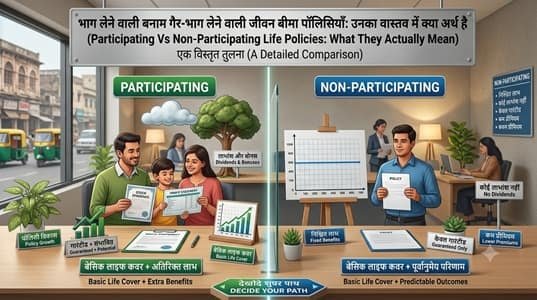
A participating policy may receive bonuses linked to the surplus emerging from the insurer’s participating business. A non-participating policy does not share in that surplus and instead provides benefits determined by its contractual terms.
Neither category is automatically better. Their suitability depends on whether the buyer values potential bonuses, clearly defined benefits, affordability or a particular financial objective.
Understanding the distinction is especially important when comparing traditional savings-oriented life insurance plans.
The Meaning of Participation in Life Insurance
The word participating does not mean that a policyholder becomes a shareholder or receives ownership rights in the insurance company.
It refers to the policy’s eligibility to share in the distributable surplus of the insurer’s participating life insurance business, according to applicable regulations and policy conditions.
This surplus can emerge from factors such as investment performance, mortality experience, expenses and other actuarial assumptions.
An insurer may distribute eligible surplus through bonuses declared for participating policies.
The policyholder’s entitlement depends on the product’s terms and the insurer’s bonus declarations.
A non-participating policy operates differently.
Its benefits are defined through the contract rather than participation in the insurer’s surplus.
These benefits may be guaranteed, non-guaranteed or a combination, depending on the particular product. Therefore, non-participating should not automatically be interpreted as meaning every payment is guaranteed.
Participating Policies: Where Bonuses Enter the Picture
Participating life insurance is commonly associated with traditional endowment, whole-life and certain money-back products.
Such policies may provide a guaranteed sum assured together with bonuses, where applicable.
In India, participating policies can feature different types of bonuses.
Reversionary Bonus
A reversionary bonus may be declared periodically, depending on the insurer’s surplus and applicable bonus structure.
Once a simple reversionary bonus is declared and vested under the policy, it generally becomes part of the benefits payable according to the contract.
However, future bonus declarations are not guaranteed merely because bonuses were declared in previous years.
Terminal or Final Additional Bonus
Some participating policies may provide a terminal bonus or final additional bonus when specified conditions are satisfied.
This is typically considered at a qualifying claim or maturity event.
Such bonuses are not necessarily payable under every policy or in every circumstance.
The important distinction is between bonuses already vested under the policy and future bonuses that remain uncertain.
Non-Participating Policies: Benefits Without Surplus Sharing
Non-participating policies do not receive bonuses through participation in the insurer’s surplus.
Instead, benefits are determined by the product design.
A traditional non-participating savings plan may specify guaranteed maturity benefits or regular income payments, provided the relevant contractual conditions are fulfilled.
Pure term life insurance is also commonly structured on a non-participating basis.
In that case, the policy primarily provides a death benefit during the coverage period rather than accumulating bonuses.
Some non-participating products may include benefits that are not guaranteed. Buyers must therefore examine the actual policy wording instead of relying only on the non-par classification.
Comparing the Two Policy Structures
| Feature | Participating policy | Non-participating policy |
| Share in insurer’s surplus | Yes, under applicable terms | No |
| Bonus eligibility | May receive declared bonuses | No participating surplus bonuses |
| Future benefit certainty | Some benefits may depend on future bonuses | Depends on contractual guarantees |
| Common product examples | Traditional participating endowment and whole-life plans | Term plans and guaranteed savings products |
| Benefit illustrations | May show guaranteed and projected non-guaranteed benefits | Reflect the particular product’s benefit structure |
| Main consideration | Potential additional bonuses | Contractually defined benefit design |
This comparison describes the policy structures, not a ranking of their financial performance.
Why Bonus Illustrations Can Be Misleading
Participating policy illustrations may show projected benefits under prescribed assumed investment return scenarios.
These illustrations help customers understand possible outcomes, but they should not be mistaken for guaranteed maturity amounts.
For example, a participating endowment plan may display a guaranteed sum assured and projected future bonuses.
The actual bonuses declared over the policy term can differ from those projections.
A buyer should identify which amounts are contractually guaranteed and which depend on future experience.
This distinction is especially important when comparing a participating policy with a non-participating guaranteed savings plan.
A higher illustrated maturity amount does not necessarily establish that one policy will deliver a better actual result.
Premiums, Returns and the Cost of Protection
Participating and non-participating policies may have different premium structures because their benefits and guarantees differ.
However, it would be inaccurate to claim that participating policies are always more expensive or that non-participating policies always produce better returns.
Premiums depend on the insured person’s age, policy term, sum assured, product design and underwriting requirements.
Similarly, maturity outcomes depend on the benefits promised and, for participating policies, the bonuses actually declared.
Life insurance also involves protection costs and other product features.
It should not be evaluated solely as an investment without considering the insurance benefit being purchased.
Which Policy Fits Different Financial Objectives?
A participating policy may appeal to someone who wants traditional life insurance protection with the possibility of additional bonuses over time.
However, that person must be comfortable with uncertainty surrounding future bonus declarations.
A non-participating guaranteed savings plan may suit someone who prioritises clearly specified contractual payouts.
For someone seeking substantial life cover at a relatively affordable premium, a pure term insurance plan may be more relevant than either type of savings-oriented policy.
The decision should begin with the purpose of the insurance.
Protection needs, premium affordability, liquidity requirements and policy duration matter more than whether the brochure says par or non-par.
Frequently Asked Questions
Q1. What does participating mean in life insurance?
A: A participating life insurance policy is eligible to share in the distributable surplus of the insurer’s participating business through bonuses, subject to the applicable policy conditions and regulatory framework.
Q2. Are bonuses guaranteed in participating policies?
A: Future bonuses are generally not guaranteed. Bonuses already declared and vested under the policy may become payable according to the contractual terms.
Q3. Is a non-participating life insurance policy always guaranteed?
A: No. Non-participating means the policy does not share in the insurer’s participating surplus. Whether particular benefits are guaranteed depends on the product’s contractual provisions.
Q4. Which is better: participating or non-participating life insurance?
A: Neither is universally better. Participating policies may provide additional bonuses, while certain non-participating products offer clearly defined guaranteed benefits. Suitability depends on individual objectives and policy conditions.
Q5. Can a term insurance policy be non-participating?
A: Yes. Pure term insurance policies are commonly non-participating because they provide specified life protection without sharing in the insurer’s surplus through participating bonuses.