 By Ramakant Dua
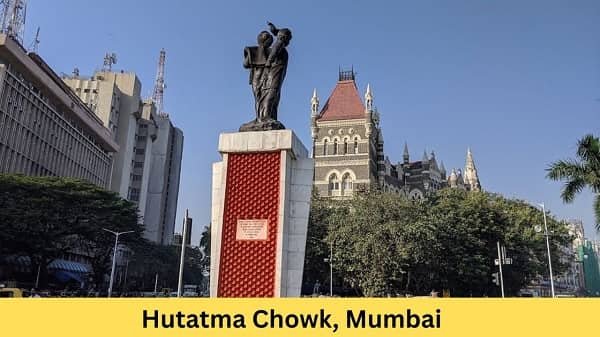
 Hutatma Chowk — officially Hutatma Smarak Chowk, meaning Martyrs’ Memorial Square — is one of the most iconic, historically profound, and architecturally magnificent public squares in Mumbai, Maharashtra, India. Located in the heart of South Mumbai’s prestigious Fort financial district at the convergence of Dadabhai Naoroji Road, Mahatma Gandhi Road, and Veer Nariman Road, this legendary chowk is home to two of Mumbai’s most celebrated landmarks: the Flora Fountain — a magnificent 1864 Portland stone heritage monument depicting the Roman Goddess Flora — and the Hutatma Memorial, a moving statue of a flame-bearing martyr commemorating the 106 lives lost during the Samyukta Maharashtra Movement. Known as the ‘Piccadilly Circus of Mumbai’ for the five roads that meet at its grand circular junction, Hutatma Chowk occupies the very site where the original Churchgate of the historic Bombay Fort once stood.
In 2026, Hutatma Chowk stands magnificently restored and more visited than ever. The Flora Fountain — which underwent a comprehensive restoration that rediscovered its original plumbing system with 64 spouts including lion-head and fish-shaped nozzles, and even revealed a concealed chamber with antique valves and old bottles — has been returned to its full historic glory. Surrounded by Victorian and Neo-Gothic colonial-era heritage buildings, framed by the Bombay High Court, St. Thomas Cathedral, and the Rajabai Clock Tower, lined with book stalls and the scent of history, and alive with the energy of one of India’s greatest financial and commercial capitals, Hutatma Chowk remains the single most important and evocative public square in all of Mumbai.
Hutatma Chowk Mumbai Quick Details
| Category | Details |
| Location | Hutatma Chowk, Dadabhai Naoroji Road, Fort, South Mumbai – 400001 |
| Also Known As | Flora Fountain; Martyrs’ Square; Piccadilly Circus of Mumbai |
| Nearest City | Thane (~35 km), Navi Mumbai (~25 km) |
| Highway | Connected via Eastern Freeway and Western Express Highway |
| Key Roads | Dadabhai Naoroji Road, Mahatma Gandhi Road, Veer Nariman Road, Churchgate Road |
| Nearest Railway Stn | CSMT (Chhatrapati Shivaji Maharaj Terminus) (~500 m walk) / Churchgate (~1 km) |
| Nearest Metro | Mumbai Metro Line 3 (Aqua Line) — Marine Lines / CSMT stations |
| Nearest Airport | Chhatrapati Shivaji Maharaj International Airport (~25 km) |
| Bus Connectivity | BEST buses, taxis, autos, app-based cabs |
| Iconic Landmark | Flora Fountain (1864), Hutatma Memorial Statue (1961), Amar Jyot (Eternal Flame) |
| Renamed | 1960 — in honor of 106 martyrs of Samyukta Maharashtra Movement |
| Importance | Historical, political, heritage, financial & cultural landmark |
| Nearby Areas | Fort, Churchgate, Kala Ghoda, Colaba, Nariman Point, Horniman Circle |
| Pin Code | 400001 |
| Admin Body | Brihanmumbai Municipal Corporation (BMC) |
| Heritage Status | Flora Fountain declared a Grade I Heritage Structure |
1. Location & Identity of Hutatma Chowk
Hutatma Chowk is located at one of the most historically extraordinary spots in all of India — the site where the Churchgate of the original Bombay Fort once stood before its demolition in 1860 by Governor Sir Bartle Frere. The square sits at the southern end of Dadabhai Naoroji Road — one of South Mumbai’s most important arterials — where five streets converge in a circular arrangement that has earned it comparison to London’s Piccadilly Circus. The square is equidistant between Chhatrapati Shivaji Maharaj Terminus (CSMT) to the east and Churchgate Station to the west — making it arguably the most central and accessible public square in the city.
The Fort district surrounding Hutatma Chowk is Mumbai’s original financial and institutional heart — a concentrated zone of Victorian and Neo-Gothic heritage buildings housing the Bombay High Court, Mumbai University, the Asiatic Society Library, the Reserve Bank of India, and India’s most important financial institutions. Walking from Hutatma Chowk toward Horniman Circle, Kala Ghoda, or Colaba is one of the finest heritage walking experiences available anywhere in India.
The identity of Hutatma Chowk is shaped by:
- The Flora Fountain (1864) — a Grade I Heritage Structure and one of Mumbai’s most beloved civic monuments
- The Hutatma Memorial (1961) and the Amar Jyot (Eternal Flame) — honoring the 106 martyrs of the Samyukta Maharashtra Movement
- Its position at the heart of South Mumbai’s Fort financial district — the institutional and commercial capital of India
It is often described as:
- The soul of South Mumbai — where history, heritage, and the daily rhythm of the city’s greatest financial district converge
- The Piccadilly Circus of Mumbai — five roads meeting at a grand circular fountain-square
The square is surrounded by:
- The Bombay High Court, Elphinstone College, Asiatic Society Library, and other Victorian-era institutional buildings
- Book stalls, heritage walk starting points, and offices of India’s leading law firms, financial institutions, and corporations
- The Central Telegraph Office, Oriental Building, Ismail Building, and Yusuf Building
Administered by: Brihanmumbai Municipal Corporation (BMC), responsible for civic maintenance, heritage conservation, and urban management across Mumbai.
2. Connectivity & Transport Infrastructure
Hutatma Chowk enjoys what is arguably the finest transit connectivity of any public square in India — the simultaneous proximity of two major suburban railway stations, Mumbai Metro, BEST buses, and its position in the walkable Fort heritage precinct.
1. Road Connectivity
Dadabhai Naoroji Road (DN Road):
One of South Mumbai’s most important and historically significant roads, DN Road connects Hutatma Chowk to CSMT in the east and runs northward through the Fort district. Named after the Grand Old Man of Indian nationalism — Dadabhai Naoroji, who was born in Navsari, Gujarat, and became India’s first Member of the British Parliament — DN Road is one of the most heritage-rich streets in India, lined with colonial-era buildings that together constitute one of the world’s finest collections of Victorian Gothic and Neo-classical architecture.
Mahatma Gandhi Road (MG Road) and Veer Nariman Road:
These roads radiate from Hutatma Chowk connecting it to Kala Ghoda, Colaba, Churchgate, and the broader South Mumbai peninsula. Together with DN Road, they form the five-road convergence that gives the square its Piccadilly Circus character and ensures it remains one of Mumbai’s most traversed and visible public spaces.
2. Metro & Rail Connectivity
Chhatrapati Shivaji Maharaj Terminus (CSMT):
A UNESCO World Heritage Site and one of India’s most magnificent railway stations — designed by architect F.W. Stevens and completed in 1888 in the Victorian Gothic style — CSMT is just 500 metres from Hutatma Chowk on foot. The station is the terminus of the Central Railway suburban network and provides connectivity to Thane, Kalyan, and all of eastern Mumbai’s suburban zones.
Churchgate Railway Station:
Approximately 1 km from the chowk, Churchgate is the terminus of the Western Railway suburban network, connecting Hutatma Chowk to Bandra, Andheri, Borivali, Virar, and all western Mumbai suburbs. Together with CSMT, these two stations make Hutatma Chowk one of the most train-connected public spaces in the world.
Mumbai Metro Line 3 (Aqua Line):
The Marine Lines and CSMT stations on the Aqua Line bring metro connectivity to the Hutatma Chowk zone, connecting South Mumbai’s financial district to the airport and the northern suburbs for the first time via underground rapid transit — a transformative addition to South Mumbai’s commuter options.
3. Public Transport & Movement
- BEST buses run extensive South Mumbai routes through the Fort area passing Hutatma Chowk
- Kaali-peeli taxis remain iconic and widely available in South Mumbai
- App-based cabs (Ola, Uber, Rapido) serve visitors and professionals throughout the day
- Walking is the most enriching way to experience Hutatma Chowk — the entire Fort heritage precinct is highly walkable
Hutatma Chowk’s 500-metre proximity to CSMT — a UNESCO World Heritage Site — makes it one of the most dramatically railway-adjacent major landmarks anywhere on earth, with one of history’s finest Victorian railway stations visible in the same vista.
3. Historical Background & Cultural Significance
Hutatma Chowk is one of the most historically layered public spaces in India — a site where colonial engineering, the Indian freedom struggle, the birth of Maharashtra, and the ongoing vitality of Mumbai’s financial capital all coexist in permanent, powerful proximity.
Flora Fountain — 1864 to Present
The Flora Fountain was built in 1864 at a cost of Rs. 47,000 — a very large sum at the time — by the Agri-Horticultural Society of Western India, with a Rs. 20,000 donation from the philanthropist Cursetjee Fardoonjee Parekh. Designed in England and transported by ship to India, the fountain was carved entirely from Portland stone and depicts Flora, the Roman Goddess of flowers and spring, standing seven feet tall atop a 25-foot column. At its base, four figures representing the seasons are surrounded by fish and lion-head spouts — 64 in total — that spray water in an elaborate plumbing system that was rediscovered during a recent restoration when a concealed chamber with antique valves was found beneath the square. The fountain stands on the exact site of the original Churchgate — one of the three gates of the historic Bombay Fort — and Sir Bartle Frere, the Governor who ordered the fort’s demolition and transformed Bombay into a modern city, was the intended namesake of the fountain before the name was changed to Flora Fountain before its unveiling.
The Samyukta Maharashtra Movement & Renaming
On 21 November 1955, a peaceful demonstration by the Samyukta Maharashtra Samiti — demanding the creation of a unified Marathi-speaking Maharashtra state — was violently dispersed by police at Flora Fountain in Mumbai, resulting in the death of 106 demonstrators. This tragedy proved to be a decisive turning point in the Samyukta Maharashtra Movement, galvanizing public outrage and accelerating the political process that led to the formation of Maharashtra on 1 May 1960. To honor the martyrs who gave their lives at this spot, the square was renamed Hutatma Chowk — Martyrs’ Square — and the Hutatma Memorial statue of a flame-bearing patriot was erected in 1961. The Amar Jyot (Eternal Flame) burns at the memorial as a permanent tribute to their sacrifice. A marble memorial at the chowk bears the names of all 106 martyrs.
Iconic Landmarks Nearby
- CSMT (Chhatrapati Shivaji Maharaj Terminus) — UNESCO World Heritage Site, 500 m away
- Bombay High Court — the majestic Gothic Revival court building, one of Mumbai’s finest architectural landmarks
- Asiatic Society Library (Town Hall) — built in 1833, housing rare manuscripts and one of India’s finest heritage libraries
- Rajabai Clock Tower and Mumbai University Library — magnificent Victorian Gothic structures
- Thomas Cathedral (1718) — one of Mumbai’s oldest churches
- Horniman Circle — a beautifully restored Victorian garden square
- Kala Ghoda Arts District — Mumbai’s premier arts and culture precinct
The Fort district surrounding Hutatma Chowk is arguably the finest concentration of Victorian Gothic and Neo-classical architecture outside the United Kingdom — a fact recognized globally and locally through heritage walk itineraries that virtually always begin or end at Flora Fountain.
Cultural Significance
Hutatma Chowk represents:
- The sacrifice of 106 Marathi-speaking patriots whose deaths gave birth to the state of Maharashtra
- The British colonial engineering legacy of Flora Fountain and the Fort district’s extraordinary heritage buildings
- The living, breathing pulse of Mumbai’s financial and institutional heart — where history is walked every workday by thousands of lawyers, bankers, traders, and city workers
4. Commercial & Cultural Activity
Hutatma Chowk and the Fort district surrounding it form the institutional and commercial heart of India — hosting the country’s most important financial, legal, and corporate establishments within a remarkably compact, walkable, and visually magnificent historic urban precinct.
The Fort Financial District
- Reserve Bank of India — India’s central bank, headquartered adjacent to the Fort precinct
- Bombay Stock Exchange (BSE) — Asia’s oldest stock exchange and India’s premier securities market, nearby at Dalal Street
- India’s leading law firms, chartered accountancy offices, and financial institutions
- National Stock Exchange (NSE) at nearby Bandra-Kurla Complex connected via Western Railway
Heritage & Tourism
- Flora Fountain heritage walks — one of Mumbai’s most popular tourist and cultural activities
- Book stalls surrounding the square — a beloved tradition of the Fort intellectual precinct
- Kala Ghoda Arts Festival — one of India’s largest arts and culture festivals, centered nearby
- Heritage architecture photography — the Fort district is a mecca for urban photographers
The area attracts:
- Financial and legal professionals working in the Fort business district
- Heritage tourists and photography enthusiasts from across India and the world
- Students and academics at the nearby educational institutions
Dining & Cafes
The Fort district surrounding Hutatma Chowk offers Mumbai’s most heritage-rich dining experience:
- Britannia and Co. — one of Mumbai’s most beloved and historic Parsi restaurants near Ballard Estate
- Kyani and Co. — a legendary Irani café near CSMT serving bun maska and chai since 1904
- Numerous art cafes, heritage restaurants, and quick lunch spots serving the Fort’s enormous office population
The food culture around Hutatma Chowk reflects both Mumbai’s Parsi and Irani café heritage and the working lunch culture of India’s financial capital.
5. Heritage & Tourism Importance (2026)
Hutatma Chowk and Flora Fountain represent one of India’s most important urban heritage assets and a major international tourism destination, with the recently completed restoration of Flora Fountain receiving widespread acclaim.
Flora Fountain Restoration
- Comprehensive restoration recovered the original 64-spout plumbing system including lion-head and fish nozzles
- A concealed chamber with antique valves and historical artifacts was discovered during restoration
- The restored fountain illuminated at night has been hailed as one of Mumbai’s finest public art experiences
- TripAdvisor visitors consistently rate the restored Flora Fountain and Hutatma Chowk as must-visit South Mumbai landmarks
Heritage Walking Culture
- Heritage walks starting from Hutatma Chowk are among Mumbai’s most popular tourism activities
- The Fort, Kala Ghoda, and Colaba heritage walk circuit — anchored by Hutatma Chowk — is considered one of the world’s great urban walking experiences
- The square’s evening illumination and the eternal flame at the Hutatma Memorial create a uniquely atmospheric nighttime experience
It is ideal for:
- Heritage and cultural tourists seeking Mumbai’s finest walking experience through Victorian Gothic architecture
- Photography enthusiasts capturing colonial architecture, fountain sculpture, and urban heritage
- History and political science scholars tracing the birth of Maharashtra through the Samyukta Maharashtra Movement
6. Social Infrastructure & Surrounding Institutions
Hutatma Chowk and the Fort district are surrounded by some of India’s most important cultural, educational, legal, and financial institutions — a concentration of institutional excellence unmatched by any other urban precinct in the country.
1. Education & Culture
- Elphinstone College (1856) — one of India’s oldest and most prestigious degree colleges
- Mumbai University — established 1857, with its magnificent Rajabai Clock Tower
- Asiatic Society Library — holding rare manuscripts, first editions, and historical documents
- Kala Ghoda Arts Festival — India’s largest multidisciplinary arts festival nearby
2. Legal & Financial
- Bombay High Court — established 1862, the oldest High Court in India in continuous use
- Dalal Street / Bombay Stock Exchange — India’s premier securities exchange, steps away
- Reserve Bank of India — India’s central bank and monetary authority
- India’s most prestigious law firms, CA offices, and investment banks within a 500-metre radius
3. Visitor Amenities
- Heritage walk tour operators offering guided walks through Fort, Kala Ghoda, and Colaba
- Art galleries of Kala Ghoda including Jehangir Art Gallery
- Numerous cafes, heritage restaurants, and quick-service dining options surrounding the square
7. Heritage Conservation & Urban Changes
Hutatma Chowk and the Fort district have benefited from Mumbai’s growing commitment to heritage conservation, driven by BMC’s heritage cell, INTACH, and the UNESCO World Heritage Site designation of CSMT.
Key Developments
- Flora Fountain’s comprehensive restoration returning it to full operational and aesthetic glory
- Mumbai Metro Line 3 (Aqua Line) bringing underground metro connectivity to South Mumbai’s heritage precinct for the first time
- Heritage precinct conservation guidelines protecting the Victorian Gothic buildings surrounding the square
- Pedestrianization works creating improved walkways and public space around the fountain
Impact
- Flora Fountain’s restoration has dramatically enhanced visitor experience and Mumbai’s heritage tourism profile
- Metro Line 3 connectivity reducing dependence on road transport and easing South Mumbai congestion
- Growing international recognition of Mumbai’s Fort district as a UNESCO-quality heritage precinct
This conservation has helped balance:
The Victorian colonial heritage of Flora Fountain and the Fort district + modern Mumbai’s metro-linked 21st century infrastructure
Conclusion
Hutatma Chowk in Mumbai is far more than a road junction or a tourist attraction — it is the beating civic heart of India’s greatest city, a site of political martyrdom that gave birth to a state, a monument to colonial engineering that has outlasted the empire that built it, and the most powerful intersection of history, sacrifice, beauty, and daily life that South Mumbai offers to the world.
In 2026, Hutatma Chowk stands fully restored and magnificently relevant. The Flora Fountain glows in the evenings with its 64 spouts restored to full life. The Amar Jyot burns steadily at the Hutatma Memorial for 106 martyrs whose sacrifice made Maharashtra. CSMT’s Victorian Gothic towers rise 500 metres away. The Bombay High Court, Asiatic Library, Rajabai Clock Tower, and Elphinstone College form a heritage skyline that rivals any in the world. And the Mumbai Metro Line 3 carries a new generation of Mumbaikars through tunnels beneath this extraordinary historic precinct.
Whether you are a financial professional walking to work through the Fort district, a tourist beginning a heritage walk at Flora Fountain, a student at Elphinstone College passing the square daily, a history lover contemplating the sacrifice of 106 Marathi patriots, a photographer capturing the restored fountain at night, or simply a Mumbaikar pausing for a moment of civic pride in the city’s most magnificent public square, Hutatma Chowk offers an experience that is irreplaceable, unforgettable, and profoundly, magnificently Mumbai.