 By Ramakant Dua
To protect building hallways during a move, cover the floors along the entire route, pad the elevator, guard door frames and tight corners, and photograph everything before and after. Confirm what your building requires first, because management usually has its own rules. Do all of that, and most scuffs, gouges, and deposit arguments never happen.
Hallways take the damage because they are narrow, shared, and busy. A sofa that clears your apartment door by an inch can still clip a corner at the first turn, and one dragged dresser leaves a mark that the next resident sees and management has to fix. This checklist follows the route in order, from your front door to the lobby, so you can see where protection matters most.
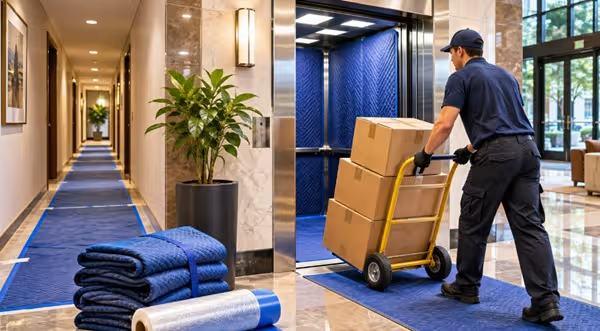
Find Out What Your Building Requires Before You Pack
Ask building management for the move-in and move-out rules in writing, since no single standard applies to every building. Some buildings supply floor and elevator protection, some expect your movers to install it, and some say nothing until a problem appears.
Send one email that asks these questions:
- Which days and hours are moves allowed, and do you need to reserve the elevator?
- Is there a separate service or freight elevator, and which entrance should movers use?
- What hallway, lobby, and elevator protection must be installed, and who provides it?
- Is a move-in deposit or fee required?
- Are there rules about propping doors open or blocking shared spaces?
Keep the replies. If a rule is only given by phone or by a doorman, ask for it in an email as well. Written answers settle disagreements later, and they also let you pass exact requirements to whoever is doing the lifting.
Walk the Route From Your Door to the Truck
Walk the exact path your belongings will travel, with a tape measure and your phone. The aim is to spot every tight spot before move day, so protection goes where damage is most likely.
Look for turns where a long item has to pivot, door frames with little clearance, lobby doors, thresholds, and any spot where the floor changes from carpet to tile or from tile to metal. Measure your largest pieces, such as a sofa, mattress, or wardrobe, against doorways, hallway width, and the elevator opening.
Say your hallway makes a sharp left outside the elevator. That corner is where a couch will swing wide, so it deserves a corner guard, and the floor beneath it deserves extra cover. Write those spots down. They become your protection list.
Cover Hallway and Lobby Floors
Lay protective runners or hard sheet material along the full path, and overlap the edges so nothing shifts underfoot. Runners work well on carpet and finished wood. Hardboard sheets, often called Masonite, hold up better where heavy loads roll or where items get set down.
A few details make the difference:
Extend coverage to the lobby, not only the upper floors. The entrance is where heavy items first hit hard flooring, and it is the area residents see most.
Pad the Elevator Before the First Load
Pad the elevator walls, door edges, and floor before anything rides in it, and leave the control panel and emergency phone uncovered. Elevators are small, and every item in them is moving in a tight box.
Moving blankets or fitted pads go on the side and back walls, usually up to handrail height or higher. Cover the floor with hardboard or a thick pad, and pay attention to the gap and metal strip at the door, since heavy items can catch on that lip. If a long piece will ride upright, protect the ceiling edge too.
Don’t wedge boxes in the door to hold it. Ask whether the building can place the elevator in service mode, or whether staff will operate it. Also check the posted weight limit, because a few large pieces plus two people can add up faster than you would think.
Guard Doorways, Corners, and Door Frames
Corner guards and door-jamb pads protect the spots that take the most abuse: outside corners at hallway turns, the edges of door frames, and the walls just inside entrances. Place them before the move starts, not after the first scrape.
Lifting beats dragging every time. A two-person carry with someone calling out the turns, such as “tilt left, wall’s close,” prevents most contact. For items that must be angled through a door, pivot them rather than pushing straight and hoping.
Take care with stair rails, banisters, and any older trim, which can crack more easily than modern fixtures. Inside your own unit, removing a door from its hinges can add a few inches of clearance. For shared doors, such as a stairwell or lobby door, ask management before touching anything.
Decide Who Supplies the Protection
Confirm in writing whether the building, you, or your movers will bring the materials, so nothing is missing on the morning of the move. A surprising number of delays come from this one gap, and a crew that arrives without runners may be told to wait.
If you hire help, choose a crew that already works in buildings like yours. In a city such as Jersey City, where many moves involve high-rises and waterfront buildings, experienced crews know the routine. As one example, some Jersey City movers ask customers up front for the building’s moving instructions, elevator reservations, stairs, loading access, and any limits on moving hours, which is the same information management usually wants.
For moves that stay inside New Jersey, check the mover’s status first. The New Jersey Division of Consumer Affairs advises confirming that a mover is licensed and has no complaints, and it says licensed movers must provide a survey of your goods and a written estimate. Ask that the estimate say what protection materials are included.
Take Before-and-After Photos
Photograph the hallway, elevator interior, lobby floor, and door frames before the first box moves, then again right after the last. Dated pictures are the simplest proof of a building’s condition if anyone questions damage later.
Shoot wide first, then close up. Stand in the same spots both times so the comparison is easy. Capture the elevator walls and floor, the corner at each turn, the lobby tile, and the frame of your own front door. Email a few of the photos to management with a short note such as “condition documented on the morning of the move.”
When the move ends, walk the route once more before the crew leaves. If you find a mark, point it out and report it to management the same day. Prompt reporting is usually easier to resolve than a surprise weeks later.
A Simple Move-Day Checklist
Use this list to keep the whole route covered, in order.
The week before
- Get building rules and elevator reservation confirmed in writing
- Walk the route and measure large items
- Confirm who is bringing runners, hardboard, pads, and corner guards
Before the first carry
- Photograph the route, elevator, lobby, and door frames
- Lay runners and hardboard, overlapping and flat
- Pad the elevator and install corner guards at turns
- Keep control panels and emergency equipment clear
During the move
- Lift, never drag
- Check runners every few trips for wrinkles and wet spots
- Keep hallways free of staged boxes
After the last load
- Remove coverings carefully so grit does not scratch the floor
- Re-photograph the route and report any damage promptly
Frequently Asked Questions
What is the best way to protect hallway floors during a move?
Lay non-slip runners or hardboard sheets along the full route, overlapping the seams. Runners suit carpet and finished wood, while hardboard handles heavy rolling loads. Keep them flat, since a wrinkle is a trip hazard, and check them every few trips. Confirm first whether your building allows tape on its floors.
Do I need to pad the elevator when moving into an apartment?
Often, yes. Many buildings expect elevator walls and floors to be padded, though the exact requirement is set by management. Ask in writing what is required and who supplies it. Even when it is optional, padding is inexpensive protection against scratches, and it can help you avoid fees or disputes afterward.
How do I protect door frames and corners while moving furniture?
Fit corner guards on outside corners and pads on door jambs before the move begins. Then carry items instead of dragging them, and pivot long pieces through doorways. A second person who calls out the turns can prevent most contact. Measure big items against openings beforehand so nothing gets forced.
Should I take photos before moving out of an apartment building?
Yes. Take dated photos of the hallway, elevator, lobby, and door frames before the move, and again afterward. Use the same angles for a clean comparison. Email a few to building management so there is a record. If anything is damaged, report it the same day.
How far in advance should I contact building management about a move?
Contact management as soon as you have a date, ideally a few weeks ahead. Elevator slots and loading access can fill up, and some buildings need paperwork before approval. Early contact also leaves time to arrange materials, so nothing is missing on the day.
Protect the Route, Not Just the Furniture
A damage-free move comes down to preparation. Learn the building’s rules, walk the route, cover the floors, pad the elevator, and guard the corners. None of these steps is hard, but each is easy to skip when the truck is waiting.
Finish with a second round of photos and a quick walk through the route. If the hallway looks the way it did that morning, you can hand over the keys with confidence.
 Saurav